
How to measure your child's foot at home

You don't need a Brannock device. You need a piece of paper, a pen, and your child standing still for ninety seconds.
This is the method we use ourselves, and the one we recommend to every parent who asks about sizing. It works because it captures both length and shape, which is more than a shoe-store measurement usually gets you.
What you'll need
- One sheet of A4 paper per foot
- A pen with a fine tip (not a marker, the line width matters)
- A ruler or tape measure marked in millimetres
- A flat hard floor against a wall
The method
1. Stand the child on the paper, heel against the wall.
Place the paper on a hard floor with its edge flat against the wall, and stand the child on it with their heel touching the wall. Both feet on the floor, weight evenly distributed, wearing the socks they'll normally use in the shoes. If they're sitting or balancing on one leg, the foot won't be at its working length. Avoid carpet, it compresses under weight.
2. Mark the longest toe.
For most children the longest toe is the second toe, not the big toe. Hold the pen perpendicular to the paper, straight up and down rather than angled. An angled pen adds millimetres that aren't really there.
3. Take the paper away and measure.
From the wall edge of the paper to the toe mark, in millimetres rather than centimetres. The number you want is precise.
4. Do the other foot.
Feet aren't symmetrical. One is usually a few millimetres longer than the other. Always buy for the longer foot.
5. Add growing room.
Children need 12–17 mm between the longest toe and the front of the shoe. Under 12 mm and they outgrow the shoe in weeks. Over 17 mm and the heel slips, which causes blisters and changes the way they walk.
So: longest foot measurement plus 12–17 mm gives you the inside length your shoe needs.
Or skip the arithmetic. Put the foot measurement, just the foot, into our size calculator and it returns the size and stage with the growing room already built in. It can also save the number for you, so it's there when you need the next pair.
Why this beats a shoe-store fitting
A shoe-store fitting measures the foot inside a shoe, often while the child is standing awkwardly on a metal plate. It's a quick check, not a true measurement.
The paper method does three things better:
- It catches both feet, and most children's feet are asymmetrical
- It captures the foot at its working length, weight-bearing
- It gives you a number you can carry from brand to brand
Every brand sizes differently. Our EU 28 is not the same internal length as someone else's EU 28. A precise foot measurement in millimetres lets you compare what's inside the shoe, not the label on the box.
Where the shape comes in
Length is the easy part. Shape is harder, and matters more.
A foot that measures 175 mm long can be narrow or wide, round or angular, with toes that splay or toes that sit close. Most measurement guides stop at length. We don't, because the wrong shape at the right length is still the wrong shoe.
Trace around the foot before they step off the paper and ask two questions.
Where is the widest point? It should be across the toes. If it sits behind the toes, at the ball of the foot, your child's toes have been compressed by a previous shoe and want room to spread again.
Is the front of the outline rounded or tapered? Children's feet are rounded at the front. Adult feet are tapered. Many children's shoes use a tapered last anyway, because they're scaled-down adult shoes. The outline tells you what shape your child actually has.
When to remeasure
Children's feet grow in bursts, not steadily. A child who has been the same size for four months can grow a half-size in three weeks. Common signs:
- Toes pressed flat against the front of the shoe
- A red or white line across the top of the foot when the shoe comes off
- The child taking the shoes off the second they get home
- A new dislike of shoes they used to like
If any of these show up, measure again. Don't wait for the school holidays.
The fit-check, written down
Two minutes with paper, pen and ruler, and you have a number and a shape that belong to your child rather than to a size chart. The next pair you buy is the right pair.
Most of the time, the problem with kids' shoes isn't the shoe. It's that no one measured properly. Start there.


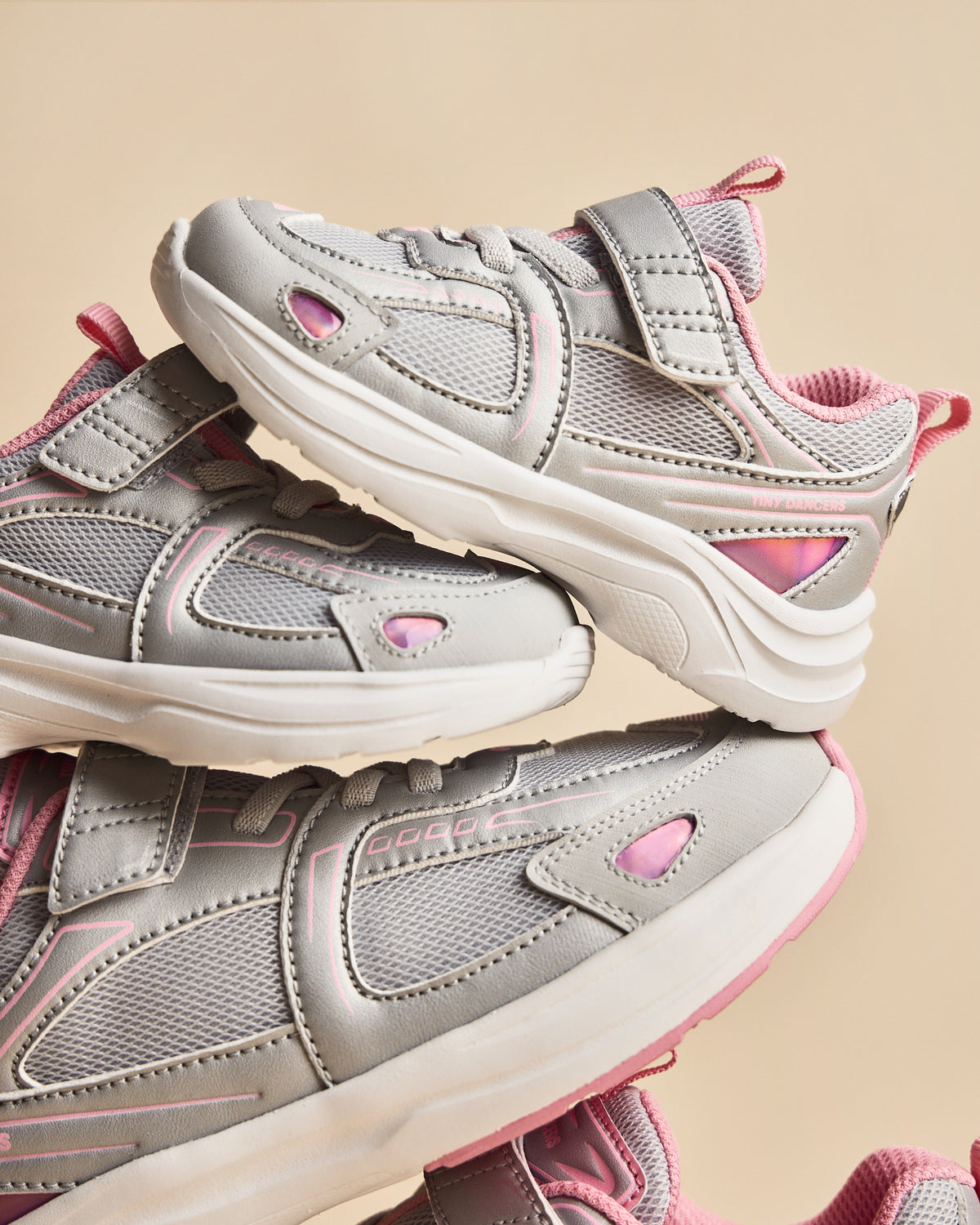
Built for the way kids actually move.
Every detail engineered for growing feet — not just scaled down from adult sizing.
Shop the collection